

Read the full story here!
Authored by Raeed Zainuddin
A great venture capital firm is built around great people: experienced operators, one-of-a-kind fundraisers and individuals uniquely attuned to predicting the future. Yet out of those three characteristics, one definitely sticks out like a sore thumb due to its ambiguity. As an operator, your track record speaks for you and illustrates clear expertise you can use to make decisions. As a fundraiser, your ability to bring in a very trackable metric in terms of dollars illustrates your mastery of convincing and maybe even some charm. So, the question remains: how can you make sure you are one of those individuals attuned to predict the future?
Some would say it is intuition, others would say it is experience, but I would argue in the pillars of venture capital that the ability to predict the future can be studied and systemized. It is no different than good old-fashioned pattern matching. Because at the end of the day, a decision without data is just a guess, and a venture capital firm without data analytics is suffering from tunnel vision.
Data analytics and data science have revolutionized multiple asset classes ever since Jim Simons invented modern quantitative trading. In fact, over 75% of public market trades are done by algorithms with an AUM of over $1 trillion (Hoover et al.). One might say this is possible only because of the abundance of data that exists when public market investing. However, I would argue that in the private markets, data is present not in the same volume as public markets, but more in terms of highly correlative signals that can be exploited to predict outcomes, which venture firms have already started using to great success.

Jim Simons, the father of algorithmic trading.
EQT Ventures created their own system called Motherbrain, which has helped them make 15 investments valued at over €200M+. In fact, Motherbrain has already picked a company that led to an exit. It was used to source Peakon, an employee feedback platform, that was sold to Workday in 2021 for $700M (Hoover et al.)(Miller). This shows the power that these highly specialized data platforms can have during sourcing and how investments in data science for venture capital firms lead to direct tangible benefits for LPs.
Sourcing is not the only vertical where data analytics can provide value. Tribe Capital spun out their data science platform into a startup called Termina. Termina assists private asset managers by providing a proprietary dataset that can be used to compare diligence results and back-test investment decisions. This information can later be used to create predictive models to analyze startup outcomes (Loizos). They have used this platform to provide crucial data to their portfolio companies and make investment decisions by extrapolating forward in time to predict outcomes (Hoover et al.).
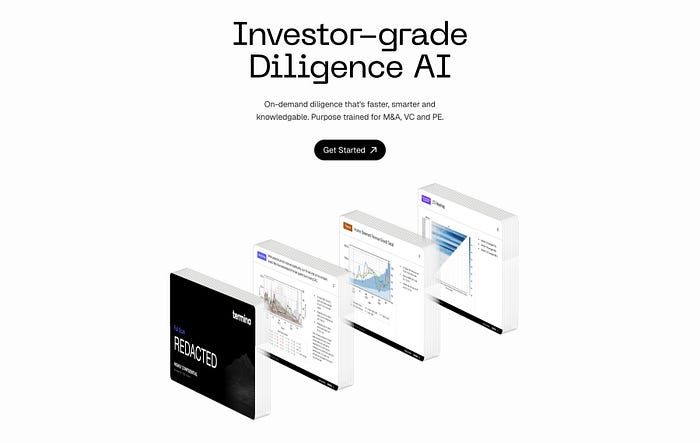
Termina bringing machine learning into private market diligence.
These are both radically different uses of data science and analytics in venture, yet they both lead to direct returns for LPs, either through intelligent sourcing or through predictive analytics. However, venture is still predominantly a people’s business, and one cannot just have algorithms running to make purely economic choices. A risk of data-addicted decisions with no human intuition can be very dangerous too, because models, at the end of the day, are just educated guesses.
So instead of replacing human intuition, data science should be thought of as an enabler. Partners already have a million high-impact decisions to make in a day, so with the use of data science and analytics, some decisions can be assisted. Finally, great operators or experienced fundraisers can be objectively considered individuals attuned to predict the future. Because after all, the future won’t be guessed. It will be modeled, tested, and sharpened by data.
Works Cited
Hoover, Ryan, et al. “The Data Revolution in Venture Capital.” Signatureblock.co, 2024, www.signatureblock.co/articles/the-data-revolution-in-venture-capital.
Loizos, Connie. “VC Arjun Sethi Talks a Big Game about Selling His Company-Picking Strategies to Other Investors; He Says They’re Buying It | TechCrunch.” TechCrunch, 17 Mar. 2024, techcrunch.com/2024/03/17/vc-arjun-sethi-talks-a-big-game-about-selling-his-company-picking-strategies-to-other-investors-he-says-theyre-buying-it/. Accessed 24 July 2025.
Miller, Ron. “Workday Nabs Employee Feedback Platform Peakon for $700M | TechCrunch.” TechCrunch, 28 Jan. 2021, techcrunch.com/2021/01/28/workday-nabs-employee-feedback-platform-peakon-for-700m/. Accessed 24 July 2025.