
Authored by Susan Moring | 03/10/2026
Check out this story on our Cortado Ventures Viewpoints page on Medium
Meet Tobe Energy
Tobe Energy is an Oklahoma City-based green hydrogen startup re-engineering how we split water into hydrogen and oxygen. Instead of squeezing incremental gains from legacy hardware, the team has rebuilt electrolysis from the circuit up, using resonant power electronics to eliminate most of the waste heat that plagues conventional systems. The result is a patent-pending, membrane-less electrolyzer that can cut green hydrogen costs by more than half and operate at system efficiencies above 90%.
Cortado Ventures invested in Tobe because we believe this kind of step change is what it will take for hydrogen to compete with fossil fuels on cost, reliability, and scalability. And we think Oklahoma is one of the best places in the country to prove it, with high delivered hydrogen prices, deep industrial demand, and a bench of energy operators eager to pilot new solutions.
Why Electrolysis Needed Its “LED Moment”
To understand why Tobe matters, it helps to zoom out on hydrogen. Today, most hydrogen is “gray” — made from natural gas via steam methane reforming, with significant CO₂ emissions but relatively low cost. Green hydrogen, by contrast, uses electricity (ideally renewable) to split water into hydrogen and oxygen in an electrolyzer, producing zero emissions at the point of generation. The challenge is that traditional electrolyzers waste a lot of energy as heat, rely on expensive materials, and are typically operated in centralized plants that sit far from end users.
Tobe likens its electrolysis technology to the improvement of LEDs over incandescents. Incandescents made light by heating a filament until it glowed, dumping most of the energy as heat. LEDs generate light through a far more efficient process, delivering much more brightness for the same power draw. Electrolysis is at a similar inflection point. In many existing systems, roughly half the energy you put in is effectively lost as waste heat, and the hardware has to be overbuilt to manage that thermal load.
Tobe’s insight is to treat the electrolyzer less like a static lump of metal and more like part of a finely tuned power circuit. By integrating the electrolysis cell into a resonant power converter — essentially using capacitive coupling and carefully shaped, pulsed signals — the system can focus energy precisely at the interface where hydrogen forms, instead of overheating everything around it. That shift dramatically reduces thermal losses, lowers material stress, and enables much higher overall efficiency in a compact package.
Most green hydrogen startups are trying to make electrolysis a little better. Tobe figured out how to make it fundamentally different.
How Tobe’s Technology Works
At a high level, Tobe’s system still does the familiar thing: it takes water and electricity and turns them into hydrogen and oxygen. The difference lies in how the power gets from the grid (or a renewable source) into the cell that’s actually splitting water.
In most conventional electrolyzers:
- Power flows as a steady, high current through the stack.
- The stack runs hot, so you need membranes, exotic metals, and complex cooling systems.
- A lot of the energy ends up as waste heat instead of useful hydrogen.
Tobe flips this approach:
- The electrolysis cell is wired as part of a resonant circuit (a bit like tuning a guitar string so it naturally vibrates at the right note).
- Instead of brute-force current, the system sends precision-shaped pulses at or near the circuit’s resonant frequency, which boosts voltage inside the cell without cranking up total power.
- Because energy is delivered more surgically, the cell can operate near ambient temperature, with little to no waste heat and no need for rare earth metals or delicate membranes.
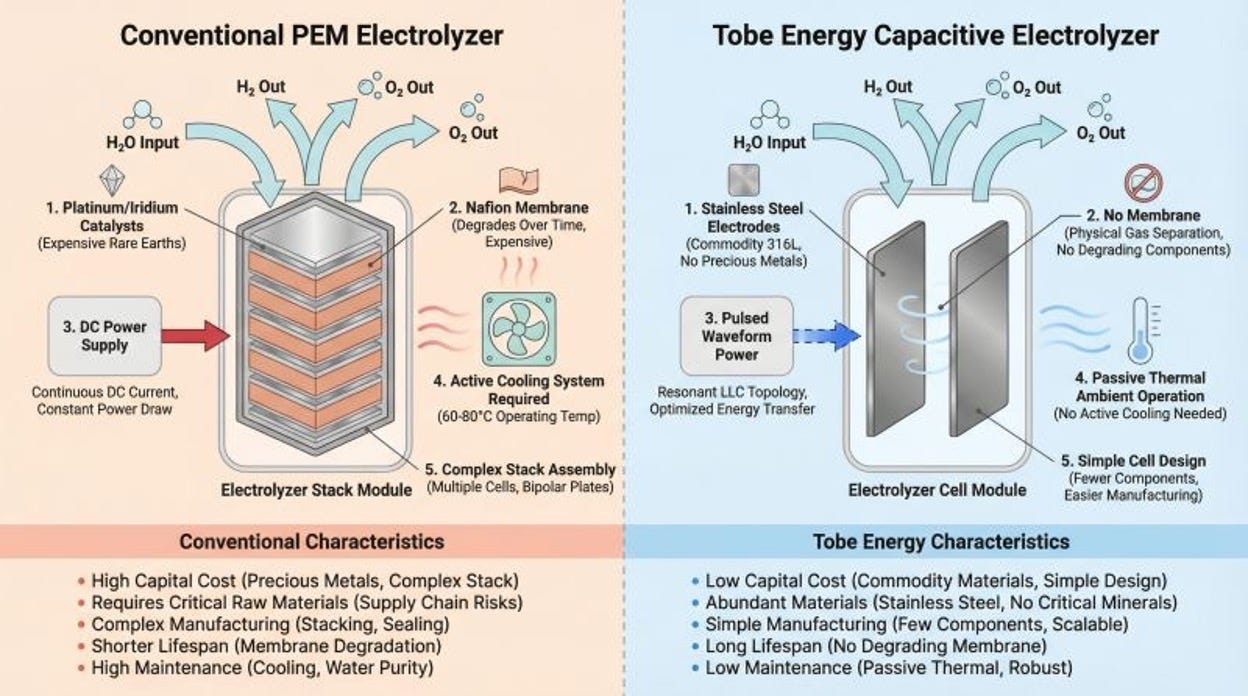
In practice, this delivers stack efficiencies in the mid-90% range and system efficiencies above 92% on a higher-heating-value basis, with energy consumption in the low-40 kWh per kilogram of hydrogen. These numbers are a step change versus many existing systems. The hardware is designed to be modular and built from standard stainless steel, making it easier to manufacture and maintain at scale. The power electronics, though also modular, are purpose-built for the architecture (rather than off-the-shelf).
Making Green Hydrogen Actually Pencil Out
Technology only matters if the economics work. There are two big unlocks that drive Tobe’s ability to produce green hydrogen at cost parity to current gray hydrogen:
1) Lower cost per kilogram. Thanks to higher efficiency and lower capital costs, Tobe projects the ability to produce green hydrogen for under $1.50 per kilogram at scale, with current all-in costs estimated around $5 per kilogram and room to fall as systems scale. That compares favorably with renewable-derived hydrogen that can cost three times as much and with delivered hydrogen in markets like Oklahoma that currently fetch $25–35 per kilogram.
2) Distributed, customer-proximate deployment. Today, many industrial users truck hydrogen in from large centralized plants. That delivery drives up the end user hydrogen price as they’re paying a premium for logistics and storage. Tobe’s units are compact and modular enough to be sited directly at or near customer facilities (combustion companies, universities, hospitals, data centers, or industrial campuses). That reduces transport costs and allows Tobe to structure long-term offtake agreements or revenue-linked site vehicles that better align incentives.
The traction so far is encouraging for a pre-seed-stage hardware company. Tobe has multiple signed letters of intent and a pipeline worth nine figures. They are actively working with Zeeco, a global leader in combustion technology, to put a Tobe unit at its Advanced Research Complex in Broken Arrow. The company has secured NSF and other non-dilutive funding to help de-risk the first commercial deployment.
Why Hydrogen Matters More Than Ever
The backdrop for energy demand is rapidly changing, especially around AI and high-performance computing. Global electricity use from data centers is projected to more than double from about 415 terawatt-hours in 2024 to roughly 945 terawatt-hours by 2030, a load comparable to the entire power consumption of Japan, driven largely by AI workloads.[i] In the U.S., data centers already account for more than 4% of national electricity demand, and some analyses suggest that share could climb toward the low double digits by the end of the decade if current build-out trends continue.[ii] At the same time, hydrogen demand is expected to rise 20–40% by 2030[iii] as new applications in transport, shipping, aviation, and heavy industry begin to come online, with liquid hydrogen alone projected to become an $80-plus-billion market by 2034 on the back of growing aerospace and space-launch activity.[iv] Put simply, we’re heading into a decade where energy-hungry data centers and a rapidly expanding hydrogen-and-space economy will need enormous amounts of clean, dispatchable power, and we believe technologies like Tobe’s are one of the few realistic ways to meet that demand without locking in more fossil fuel infrastructure.
A Founder Built for Hard Problems
Tobe’s story starts with founder and CEO Colby DeWeese, a University of Tulsa-trained chemical engineer who has spent his career inside the energy system he’s now trying to disrupt. Before Tobe, Colby led large-scale projects at Marathon Petroleum. He then shifted into renewables as principal process engineer at Hydrogen Technologies, helping design and deliver a first-of-its-kind zero-emission hydrogen boiler. That mix of deep process engineering and real-world project management is rare in early-stage climate tech. Colby has also emerged as a visible voice for hydrogen innovation (watch his TEDx talk HERE) and is a repeat collaborator with major industrials like Zeeco. He’s a lifelong tinkerer from a family of tinkerers (his dad helped invent TiVo!), and that builder mentality shows up in how Tobe prototypes, tests, and iterates hardware.
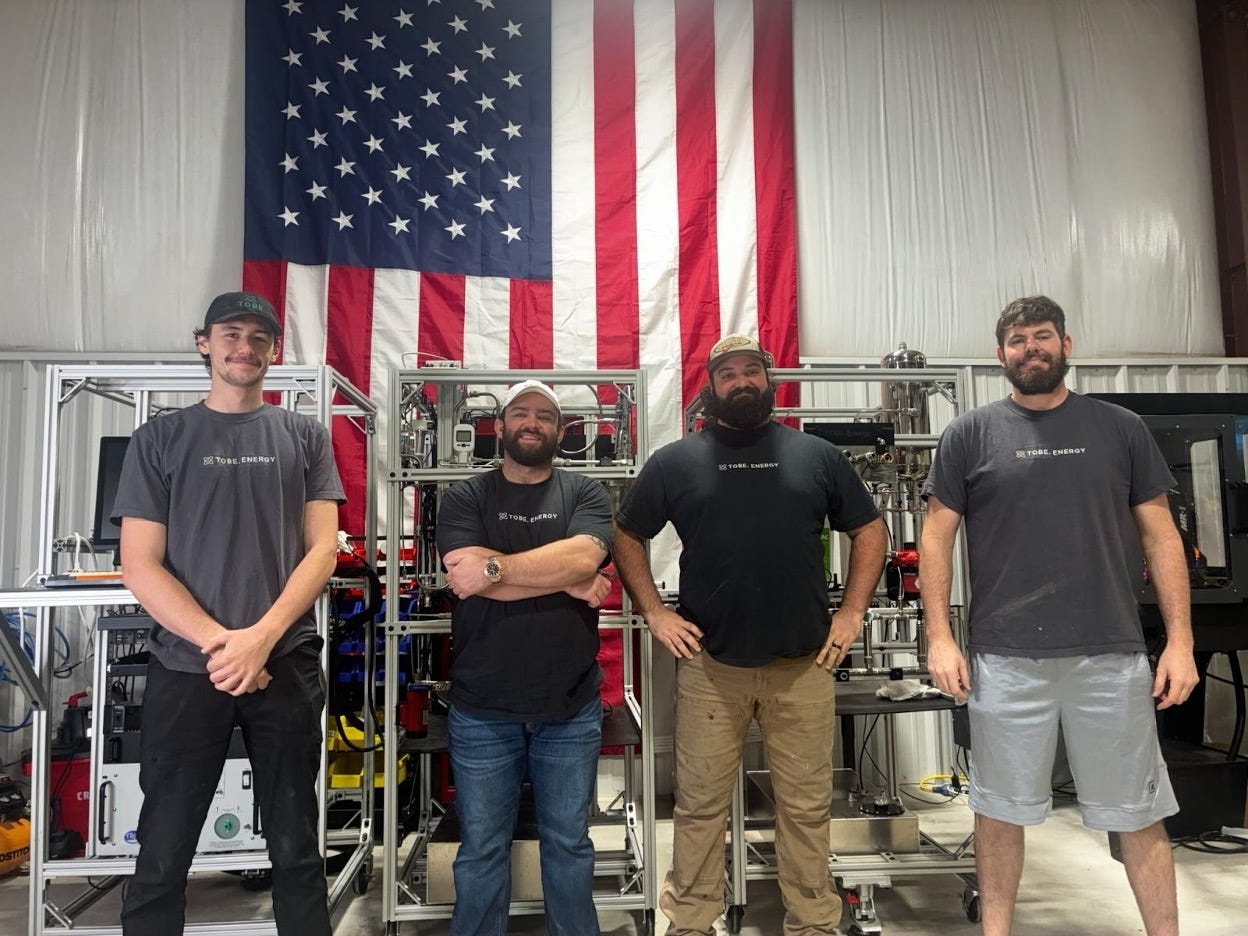
Tobe’s co-founders complement that core with scientific and commercial depth. Dr. Caleb Lareau, a Harvard PhD and Stanford postdoc, brings a rigorous, research-driven approach to systems design and scaling. Louis Mounsey, a chemical engineer and seasoned hydrogen sales leader at Arkema, is leading finance and commercial operations. Together, the team looks less like tourists in the energy transition and more like insiders who know where the bodies (and the bottlenecks) are buried.
Looking Ahead
As an Oklahoma-based fund with a thesis around backing early-stage founders innovating in legacy sectors, it’s hard to imagine a stronger investment fit for Cortado than Tobe Energy. We’ve already been able to help Tobe connect with early customers and partners in the region, and we expect those local relationships to compound in value as the company scales. More broadly, we believe companies like Tobe can help define Oklahoma’s role in the energy transition — not by walking away from the state’s legacy strengths, but by retooling them for a lower-carbon future.
We don’t take hardware bets lightly, especially in markets as capital-intensive and policy-sensitive as hydrogen. There are real risks around scale-up, execution, and long-term regulatory stability, and Tobe still has work to do to prove out its performance at commercial scale. But the combination of a uniquely qualified founding team, a genuinely differentiated technology, strong early demand, and a home-field advantage in Oklahoma makes this a risk we’re excited to underwrite.
If Tobe is successful, green hydrogen stops being a niche, long-dated aspiration and starts looking like a practical tool for decarbonizing real assets in real places. That’s the kind of future we want to help build.
[i] https://www.datacenterdynamics.com/en/news/iea-data-center-energy-consumption-set-to-double-by-2030-to-945twh/
[ii] https://www.eenews.net/articles/data-centers-share-of-us-electricity-seen-doubling-by-2030/
[iii] https://www.ics-shipping.org/wp-content/uploads/2024/07/Turning-Hydrogen-Demand-Into-Reality-Which-Sectors-Come-First.pdf
[iv] https://researchworld.com/articles/liquid-hydrogen-the-cold-fuel-powering-an-usd-81-billion-future-by-2034